
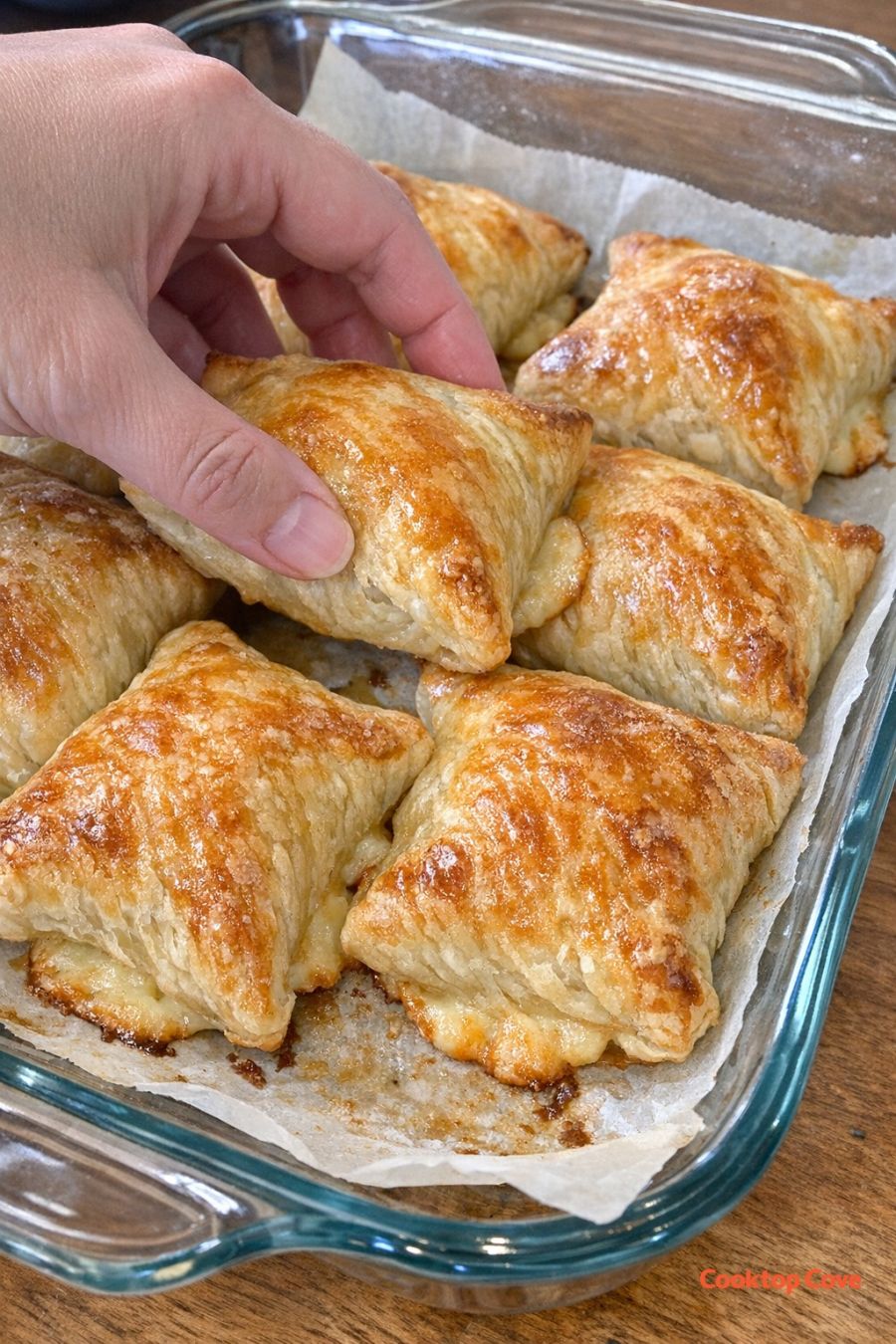
These oven baked 3-ingredient puff pastry pockets are my aunt’s not-so-secret-anymore potluck trick. They’re buttery, flaky, and just sweet enough to vanish the minute they hit the church basement table. She’s been bringing some version of these to every funeral lunch, baby shower, and Christmas program since the ’90s, and people always assume they’re complicated. In reality, they use store-bought puff pastry, a simple sweet filling, and an egg for shine. They’re perfect for busy weeknights, last-minute guests, or when you want something that looks fancy without a lot of work.
Serve these warm or at room temperature on a simple platter or right out of a glass baking dish. They go nicely with coffee, hot chocolate, or a little pitcher of cold milk for the kids. For brunch, pair them with scrambled eggs and fresh fruit. For a potluck, tuck them between the veggie tray and the crockpots of meatballs—they work as a sweet bite after a heavier plate. If you’d like to dress them up a bit, dust lightly with powdered sugar just before serving, or set out a small bowl of vanilla yogurt or whipped cream for dipping.
Oven Baked 3-Ingredient Puff Pastry Pockets
Servings: 12 puff pastry pockets
Ingredients
1 (14–16 oz) box frozen puff pastry sheets, thawed but still cold
1 cup thick fruit jam or preserves (such as strawberry, raspberry, or apricot)
1 large egg, beaten well (for sealing and egg wash)
Directions
Preheat your oven to 400°F (200°C). Lightly grease a glass baking dish or line it with parchment paper so the pockets don’t stick and you still get that pretty golden bottom.
Make sure your puff pastry is thawed according to the package directions but still cold to the touch. Cold dough gives you those flaky layers you see in the picture.
On a lightly floured surface, unfold one puff pastry sheet. Gently roll it out with a rolling pin just until the seams are smoothed and the sheet is an even rectangle, about 1/8 inch thick.
Using a sharp knife or pizza cutter, cut the sheet into 6 equal rectangles. Repeat with the second sheet so you have 12 rectangles total.
Spoon about 1 tablespoon of jam onto the center of 6 of the rectangles, leaving at least a 1/2-inch border all the way around so the filling doesn’t ooze out too much.
Crack the egg into a small bowl and beat it well with a fork. Using your finger or a pastry brush, lightly brush the beaten egg around the edges of the jam-topped rectangles. This will help seal the pockets.
Place the remaining 6 rectangles on top of the jam-topped pieces to form little pockets. Gently press the edges together with your fingers, then go around each one with the tines of a fork to crimp and seal tightly.
Transfer the sealed pockets to your prepared glass baking dish, leaving a bit of space between each so the puff pastry has room to rise and puff up.
Brush the tops of each pocket lightly with more beaten egg. This is what gives you that deep golden, shiny finish in the oven.
Use a sharp knife to cut 2–3 small slits on top of each pocket. This lets steam escape and helps keep the jam from bursting out the sides.
Bake in the preheated oven for 15–20 minutes, or until the puff pastry is puffed, flaky, and a deep golden brown on top and around the edges. Keep an eye on them near the end; every oven is a little different.
Let the puff pastry pockets cool in the glass dish for at least 10 minutes before anyone grabs one—the jam inside will be very hot and can easily burn fingers and mouths. Serve warm or at room temperature.
Variations & Tips
You can change the whole personality of these pockets just by swapping the jam. Try cherry, peach, or mixed berry for a classic potluck feel, or use lemon curd for something a little brighter. If you have picky eaters who aren’t big on fruit, you can still stay within the 3-ingredient rule by using a chocolate hazelnut spread or a thick caramel sauce instead of jam—just don’t overfill, because these run more easily. For a slightly less sweet version, use a low-sugar jam. If you want to stretch the batch for a bigger crowd, cut the pastry into smaller rectangles to make mini pockets and reduce the baking time by a few minutes. For a more breakfast-style pocket, you can mix a spoonful of jam with a spoonful of softened cream cheese, but note that this technically adds a fourth ingredient. Food safety tips: Keep the puff pastry cold until you’re ready to work with it; if it gets too warm and sticky, pop it back in the fridge for 10–15 minutes before filling. Always bake puff pastry until it is fully puffed and golden to ensure the layers are cooked through. Let the pockets cool before serving, as the jam reaches very high temperatures in the oven and can cause burns if eaten too quickly. Store leftovers in the refrigerator once fully cooled, especially in warm weather, and reheat briefly in the oven or toaster oven to crisp them back up.
