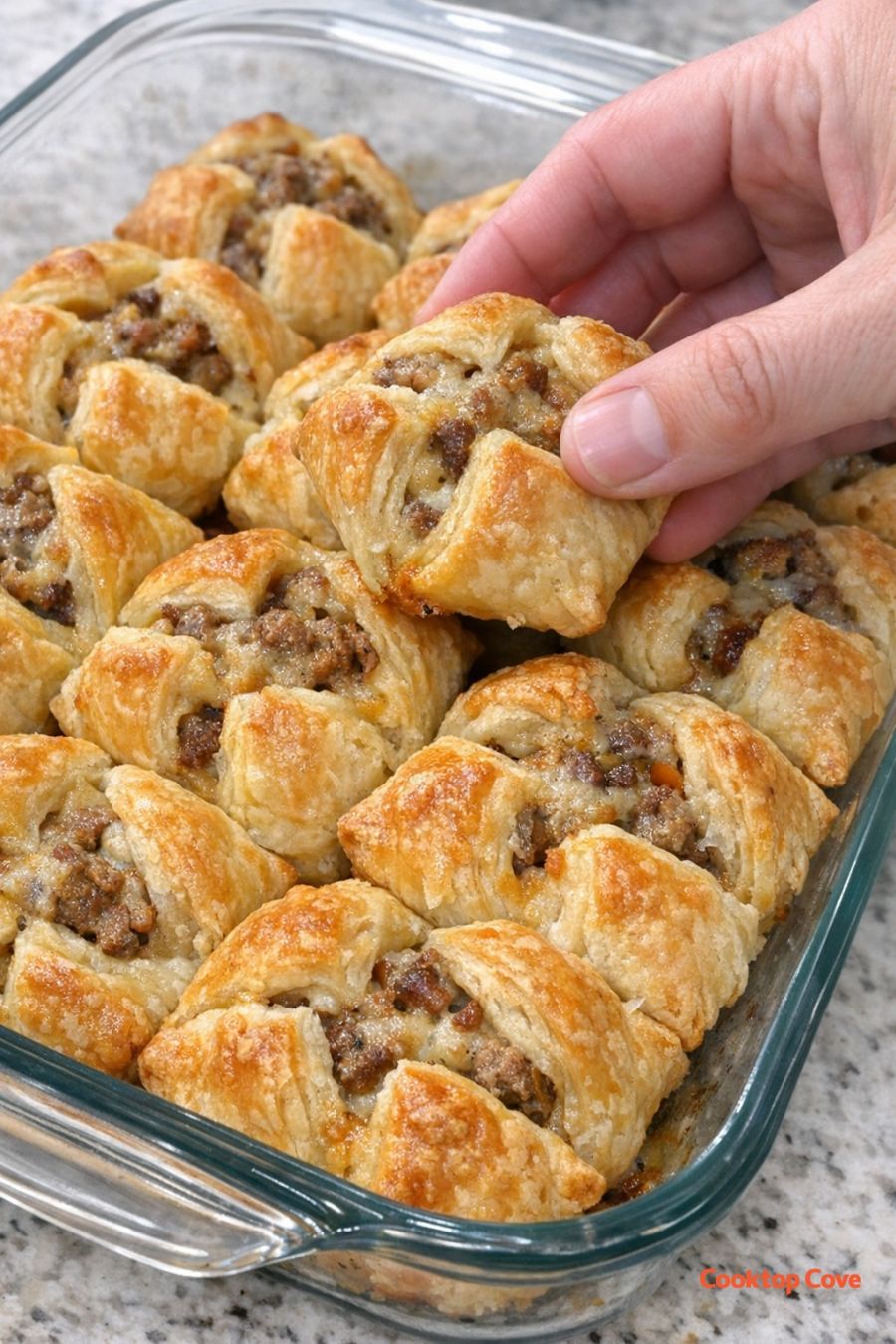
These oven baked 5-ingredient summer sausage puffs are the kind of no-fuss party food that disappears the moment you set the dish down. A friend’s grandma in a small Midwestern town made a version of these for every summer gathering, and she swore they were the only reason anyone showed up—people would hover by the kitchen waiting for the next pan. They’re essentially bite-size pockets of flaky puff pastry wrapped around a savory, cheesy sausage filling, baked until golden and bubbling. The ingredient list is short, the technique is simple, and they can be assembled ahead, which makes them perfect for casual cookouts, game nights, or any time you want something nostalgic and crowd-pleasing without a lot of effort.
Serve these sausage puffs warm, straight from the glass baking dish, with a small spread of tangy mustards (yellow, Dijon, or whole-grain) and maybe a bowl of pickles to cut through the richness. They pair well with crisp salads—think a simple tomato and cucumber salad or a vinegar-based coleslaw—and they’re right at home next to grilled corn or burgers if you’re doing a backyard cookout. For drinks, cold beer, hard cider, or sparkling water with citrus keeps things refreshing alongside the buttery pastry and savory filling.
Oven Baked 5-Ingredient Summer Sausage PuffsServings: 12–16 puffs (about 6–8 appetizer servings)
Ingredients
1 sheet frozen puff pastry (about 8–10 ounces), thawed but still cold
8 ounces fully cooked summer sausage, finely diced
1 cup (about 4 ounces) shredded sharp cheddar cheese
1/3 cup finely chopped green onion (white and green parts)
1 large egg, beaten (for egg wash)
Directions
Preheat your oven to 400°F (200°C). Lightly grease a glass baking dish (about 9x13 inches or similar) or coat it with nonstick spray so the puffs release easily after baking.
Make sure your puff pastry is thawed according to the package directions but still cold and firm to the touch. If it feels soft or sticky, place it in the refrigerator for 10–15 minutes before rolling so it’s easier to work with and puffs nicely.
In a medium bowl, combine the finely diced summer sausage, shredded cheddar cheese, and chopped green onion. Toss everything together until the sausage pieces are coated with cheese and the onion is evenly distributed. This will help the filling stay together inside the pastry.
On a lightly floured surface, unfold the puff pastry sheet. Using a rolling pin, gently roll it into a rectangle roughly 10x12 inches, smoothing out the seams but trying not to press the pastry too thin; you still want good layers for puffing.
With a sharp knife or pizza cutter, cut the puff pastry into 12–16 even squares, depending on how large you’d like your puffs. Smaller squares make more bite-size pieces for parties, while larger ones are nice for a heartier snack.
Spoon a small mound of the sausage mixture into the center of each pastry square, dividing the filling as evenly as possible. Avoid overfilling; you want enough room to seal the pastry edges so the cheese doesn’t all leak out while baking.
Working with one square at a time, fold the pastry over the filling to form either a triangle or a little parcel (bringing all four corners up toward the center). Press the edges together firmly with your fingers to seal. If the pastry seems dry and doesn’t want to stick, you can lightly dab the edges with a bit of water to help them adhere.
Arrange the filled pastry puffs seam-side up or seam-side down (either works) in the prepared glass baking dish, leaving a little space between each piece so the hot air can circulate and help them puff. They can be snug but not tightly packed.
Brush the tops of the pastry pieces lightly with the beaten egg, using a pastry brush or the back of a spoon. This egg wash gives the puffs a deep golden color and a slight sheen once baked.
Place the baking dish on the center rack of the preheated oven and bake for 18–22 minutes, or until the pastry is deeply golden, puffed, and you can see some of the cheese and sausage juices bubbling around the seams.
Remove the dish from the oven and let the sausage puffs cool in the glass baking dish for about 5–10 minutes. This rest time helps the cheese set slightly so the filling stays put when you pick them up, and it also keeps anyone from burning their mouth on molten cheese.
Transfer the puffs to a serving platter if you like, or simply set the glass dish on a trivet with a small spoon or tongs. Serve warm, and expect people to reach right in for seconds—just like my friend’s grandma’s guests did at those old summer parties.
Variations & Tips
You can easily adapt these sausage puffs to what you have on hand while keeping the spirit of that old summer-party favorite. For a slightly lighter version, use turkey summer sausage or another fully cooked smoked sausage, still finely diced so it nestles well into the pastry. If you prefer a milder flavor, swap the sharp cheddar for Colby-Jack or mozzarella; for more bite, try smoked cheddar or pepper Jack. Green onion can be replaced with very finely minced red onion or chives. To add a bit of heat without changing the ingredient count, choose a spicy variety of summer sausage or a sharper cheese. If you’d like a more breakfast-style puff, use fully cooked crumbled breakfast sausage instead of summer sausage, making sure it’s well drained and cooled before mixing with the cheese so it doesn’t melt the pastry. These can be assembled a few hours ahead: fill and shape the puffs, arrange them in the glass dish, cover loosely, and refrigerate; brush with egg just before baking. For food safety, always use fully cooked sausage for this recipe and keep it refrigerated until you’re ready to mix the filling. If you pre-cook any sausage yourself, cook it to at least 160°F (71°C), drain off excess fat, and cool it completely before combining with cheese to avoid warming the puff pastry. Don’t leave the unbaked, filled puffs at room temperature for more than about 30 minutes—keep them chilled until they go into the oven. Leftover baked puffs should be cooled quickly, then refrigerated in an airtight container and eaten within 3–4 days; reheat them in a 350°F (175°C) oven until hot and crisp again rather than microwaving, which can make the pastry soggy.