
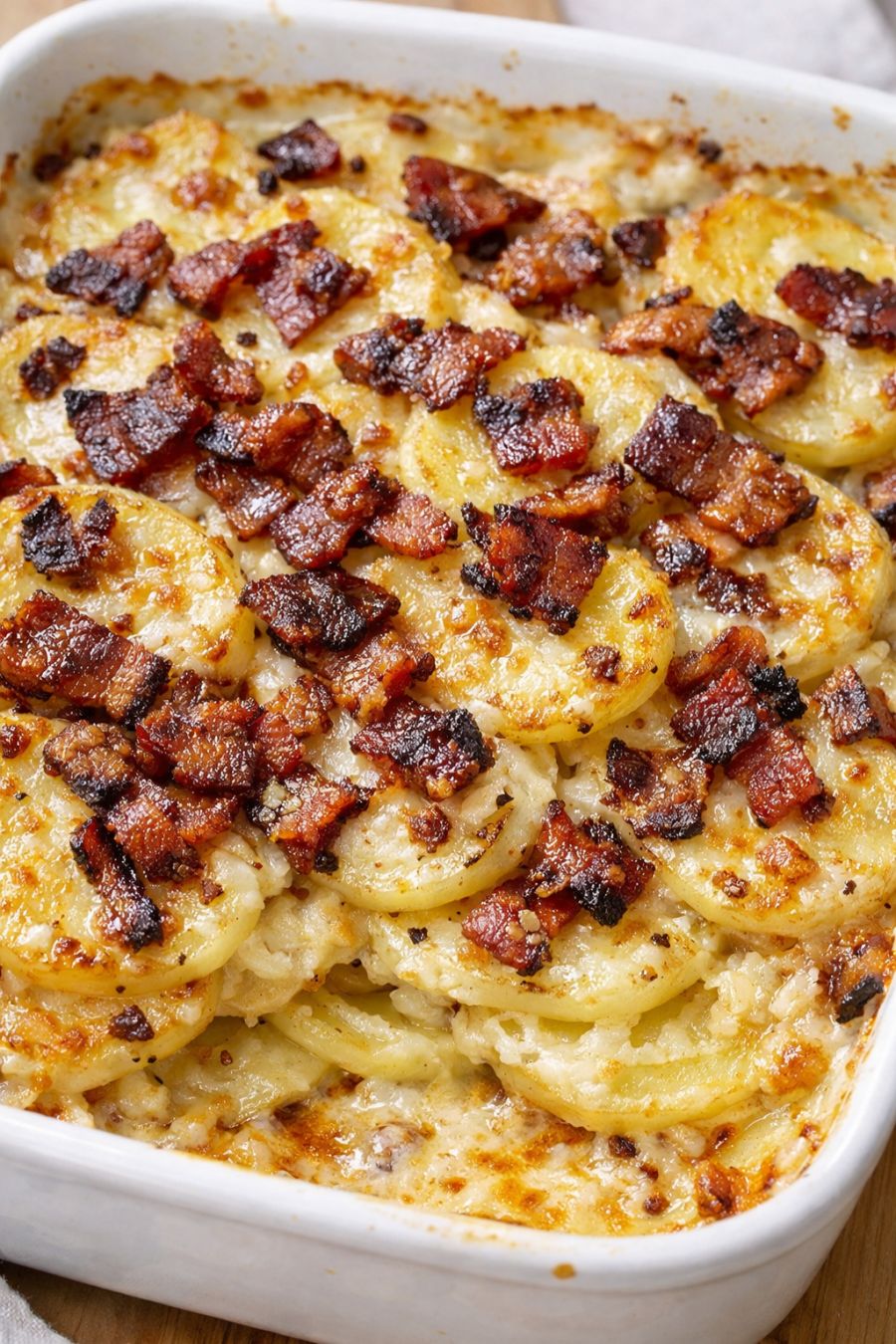
My neighbor from Belfast showed up at my back door one snowy December afternoon with a casserole dish that changed my holiday table forever. She called it her 4‑ingredient trick for a perfect side: thin potatoes, real cream, sharp cheese, and a good handful of smoky bacon, all baked until the edges bubble and the top turns crisp and golden. It reminded me of the potato dishes my mother made on the farm, but with a richer, almost company‑worthy finish that still feels wonderfully down‑to‑earth. This oven baked 4‑ingredient savory bacon potato gratin is simple enough for a weeknight, but it absolutely shines next to a holiday ham or roast, and it’s the kind of dish folks go back for “just one more spoonful.”
Serve this gratin piping hot, right out of the oven, while the potatoes are tender and the bacon on top is still crisp. It’s a natural partner for roasted turkey, holiday ham, beef roast, or simple pan‑fried pork chops. A bright green vegetable—like steamed green beans, buttered peas, or a crisp tossed salad—helps balance the richness. A basket of warm dinner rolls or a crusty loaf of bread is handy for swiping up the creamy sauce from the bottom of the dish. If you’re setting out a buffet, keep the gratin in its baking dish so the layers stay intact and that bubbling, browned top can steal the show.
Oven-Baked 4-Ingredient Savory Bacon Potato Gratin
Servings: 6
Ingredients
2 pounds russet or Yukon Gold potatoes, peeled and very thinly sliced
8 ounces thick-cut bacon, cut into small pieces
2 cups heavy cream
2 cups shredded sharp cheddar cheese, lightly packed
1 teaspoon kosher salt (optional, to taste)
1/2 teaspoon black pepper (optional, to taste
Soft butter or oil for greasing the baking dish (optional, for the pan)
Directions
Preheat your oven to 375°F (190°C). Lightly grease a medium casserole dish (about 2 to 2 1/2 quarts) with a little butter or oil so the potatoes release easily after baking.
In a skillet over medium heat, cook the bacon pieces until they are deeply browned and crisp but not burnt. This usually takes about 8–10 minutes, depending on thickness. Use a slotted spoon to transfer the bacon to a paper towel–lined plate to drain, and set it aside. You can discard the bacon grease or save it in a jar for another day, like my mother always did.
While the bacon cooks, peel the potatoes and slice them very thinly, about 1/8 inch thick. A sharp knife does the job just fine; if you have a mandoline, this is a good time to use it. Try to keep the slices as even as you can so they cook at the same rate.
Pour the heavy cream into a measuring cup or small bowl. Stir in the salt and pepper if you’re using them, tasting the cream so it’s pleasantly seasoned but not overly salty—remember the bacon and cheese will add their own saltiness. Set the seasoned cream near your baking dish so it’s ready to use.
Spread a thin, even layer of sliced potatoes over the bottom of the prepared casserole dish, slightly overlapping the slices like shingles on a roof. Scatter a small handful of shredded cheddar cheese over the potatoes, followed by a sprinkle of the crisp bacon pieces. This layering is what gives you that pretty, tight pattern you see when you scoop into the finished gratin.
Repeat the layers: potatoes, then cheese, then bacon, building the gratin up to the top of the dish. Try to reserve a generous handful of both cheese and bacon for the final top layer so the surface bakes up bubbly and crisp. Gently press down on the layered potatoes with your hands to settle them into an even layer.
Slowly pour the seasoned heavy cream over the potatoes, aiming to cover the entire surface and letting it seep down between the layers. You should see the cream just come up around the sides of the potatoes—enough to bathe the layers, but not so much that it completely drowns them. Top with the remaining cheese and the last of the bacon, spreading them evenly so every serving gets a bit of that browned, savory crust.
Cover the casserole dish tightly with foil and place it on the middle rack of the preheated oven. Bake covered for about 35–40 minutes, or until the potatoes are starting to turn tender when you slide a knife into the center. The cream will be hot and steamy underneath the foil, gently softening the layers.
Remove the foil and continue baking, uncovered, for another 20–25 minutes, or until the top is deeply golden, the bacon is crisp, and the cream is bubbling up around the edges. A knife or fork should slip through the potatoes with almost no resistance. If the top browns too quickly, you can loosely tent it with foil again for the last few minutes.
Once baked, remove the gratin from the oven and let it rest for at least 10–15 minutes before serving. This short rest helps the creamy sauce thicken slightly and the layers settle, so when you scoop into it you see those tender, thin slices of potato under a rich, bubbling sauce and a dark, crispy bacon top—just like the dish my Belfast neighbor first carried across the yard on a cold winter’s day.
Variations & Tips
If you’d like a little extra depth without complicating the recipe, you can substitute part of the cheddar with another sharp cheese, such as Irish cheddar or Gruyère, keeping the total amount the same so you still only have four main ingredients. For smaller gatherings, halve the recipe and bake it in an 8-inch square dish, checking a bit earlier for doneness. To get a head start on a busy holiday, assemble the gratin up to the point of baking, cover it tightly, and refrigerate it for up to 24 hours; add an extra 10–15 minutes to the covered baking time to account for the cold dish. If your crowd prefers a smokier flavor, use smoked bacon and a smoked cheddar, or sprinkle a pinch of smoked paprika over the top before baking (this keeps the core recipe at four ingredients but lets you play with the seasoning). For those watching salt, use unsalted bacon and a milder cheese, then season the cream lightly so you stay in control. Leftovers reheat nicely, covered, in a 325°F oven until warmed through; the top will re-crisp a bit, and the flavors seem to deepen by the next day, making this a fine make-ahead side for busy holiday kitchens.
