
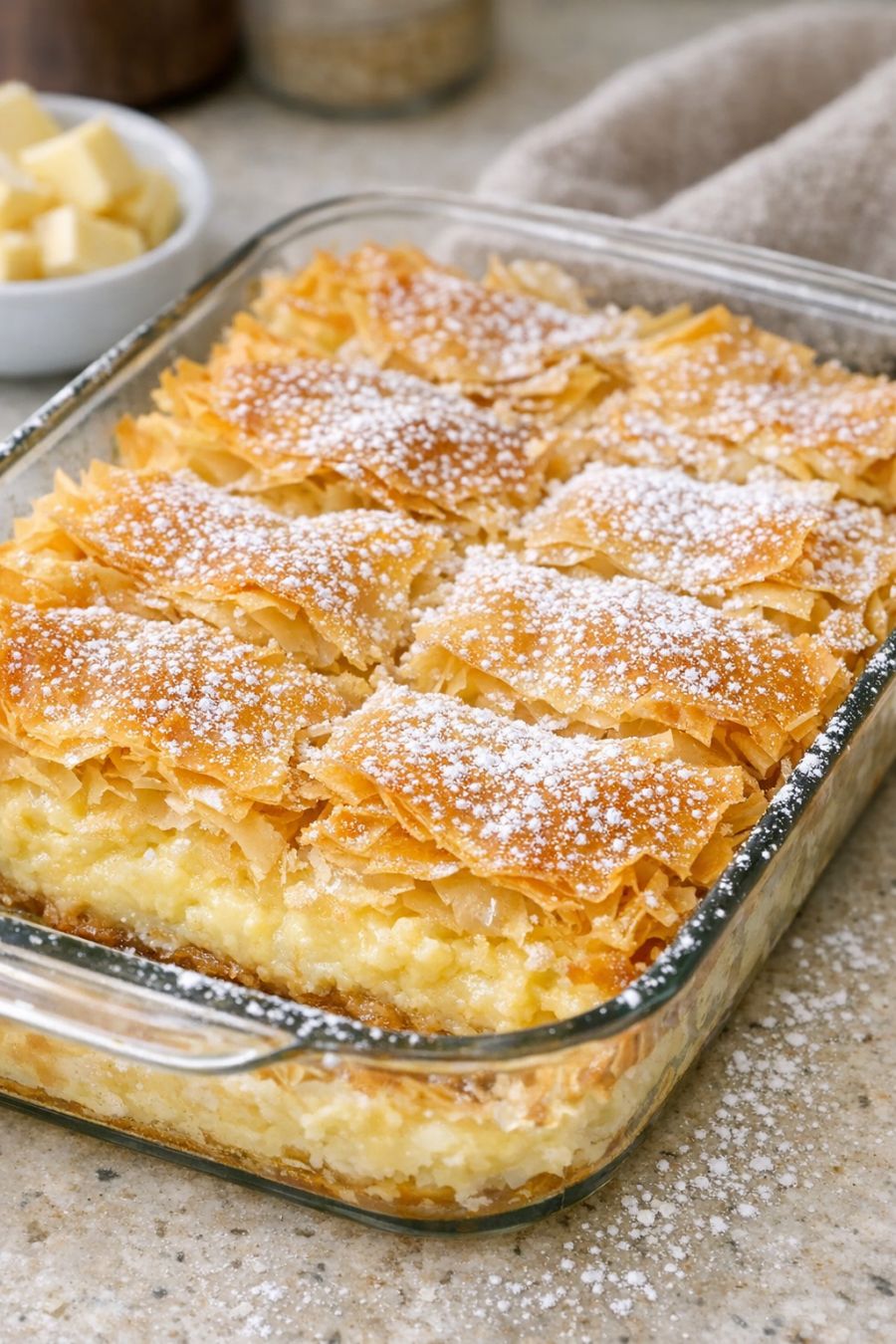
This little layered dessert reminds me of the kind of thing Midwestern church ladies used to pull together when unexpected company rolled up the driveway. It uses frozen phyllo sheets straight from the box and just three other pantry friends to make a buttery, custardy, crackly-topped treat that disappears fast. You don’t fuss with syrup or stovetop work—just dump, layer, and bake. The fragile phyllo bakes up into golden, irregular layers that soak up a sweet vanilla cream, and the whole pan looks far fancier than the effort it takes. It’s the sort of recipe you make once and then keep in your back pocket for busy holidays, potlucks, or those evenings when you want something warm and homemade without dirtying half the kitchen.
Serve this warm or at room temperature, cut into squares right from the baking dish. A dollop of softly whipped cream or a scoop of vanilla ice cream melts into all the nooks and crannies of the flaky layers. Strong coffee, after-dinner tea, or a small glass of cold milk all pair nicely with the sweet custard and crisp pastry. For a little color on the table, scatter a few fresh berries around the platter or add a simple bowl of sliced strawberries on the side.
4-Ingredient Layered Phyllo Custard Bake
Servings: 8-10
Ingredients
16 oz (about 1/2 package) frozen phyllo dough sheets, kept frozen
1 cup (2 sticks / 225 g) unsalted butter, melted
1 1/2 cups granulated sugar
4 large eggs, plus enough whole milk to make 4 cups total liquid (about 3 to 3 1/2 cups milk), with 2 teaspoons vanilla extract
Directions
Preheat your oven to 350°F (175°C). Lightly butter or spray a 9x13-inch glass baking dish.
Keep the phyllo sheets frozen in their package until you are ready to use them. Do not thaw; you want them stiff and papery so they break and layer easily.
Open the phyllo package and pull out about half of the stack (roughly 16 oz). Working quickly, take several frozen sheets at a time and lay them into the prepared baking dish, letting them overlap and crumple a bit. You don’t need to be neat—just spread them around so the bottom is covered in a loose, uneven stack of sheets. This is where you simply dump the frozen pastry into the dish and let it fall into soft folds.
Slowly drizzle the melted butter all over the frozen phyllo in the dish, trying to cover as much of the surface as you can. The butter will seep down between the layers as it bakes.
In a large mixing bowl, whisk together the sugar and eggs until well combined. Pour in enough whole milk to bring the total liquid (eggs plus milk) up to 4 cups. Add the vanilla extract and whisk until smooth. The mixture will be thin, like a pourable custard base.
Pour this sweet custard mixture evenly over the buttered frozen phyllo in the baking dish. The liquid will pool in some spots and sink in others; that’s fine. Gently press down any phyllo corners sticking far above the liquid so they don’t scorch.
Let the dish sit on the counter for 5–10 minutes so the custard can start soaking into the phyllo layers. During this time, the very top sheets will begin to soften a bit while the interior stays crinkled.
Place the dish on the center rack of the preheated oven and bake for 40–50 minutes, or until the top is puffed and deep golden brown and the custard is set in the middle. A knife inserted near the center should come out mostly clean, with no runny liquid.
If the top is browning too quickly before the center is done, lay a loose sheet of foil over the pan for the last 10–15 minutes of baking.
Remove from the oven and let the dessert cool at least 20–30 minutes. As it cools, the custard will finish setting and the layers will become easier to cut.
Cut into squares or rectangles right in the baking dish and serve warm or at room temperature. The flaky top and tender, custardy layers underneath are best the day it’s baked, when everyone will be reaching for “just one more” piece.
Variations & Tips
You can dress this up a bit while still keeping the spirit of a simple, four-ingredient dump-and-bake dessert. For a citrus twist, grate the zest of one lemon or orange into the custard mixture before pouring it over the phyllo. If you like a hint of spice, whisk in 1 teaspoon of ground cinnamon or a pinch of nutmeg with the sugar and eggs. For a nutty touch, you can sprinkle a handful of chopped walnuts or pecans between the phyllo layers as you dump them into the dish—this technically adds a fifth ingredient, but it’s a very traditional Midwestern move when you have nuts to use up. To make it a little less sweet, reduce the sugar to 1 1/4 cups; for a richer dessert, use half-and-half in place of part of the milk. Leftovers should be cooled completely, then covered and refrigerated within 2 hours for food safety, since this is an egg-and-dairy custard. Reheat individual pieces in a low oven (300°F / 150°C) for 10–15 minutes to crisp the top again rather than using the microwave, which tends to make the pastry rubbery. Always keep the raw egg mixture refrigerated if you need to pause before baking, and avoid letting the filled, unbaked dish sit out for more than about 30 minutes at room temperature. Use clean utensils and a clean cutting board when portioning, and discard any pieces that have sat out at room temperature for more than 2 hours to be on the safe side.
